I’m Rewriting!

So, I had an epic blog post planned for today, one in which I was going to discuss my on-going rewrite of a book that was “done” a year ago. Then my daughter fell on her face (literally) while we were walking our dogs last night and I ended up spending two hours at the ER, then another at Denny’s because she wanted late night pancakes, sausage, and ice cream. Who am I to deny?

*SADNESS*

Anywho… I actually AM starting a rewrite. And good news–it’s getting easier. Know why? Because I’ve finally figured out the trick to a successful rewrite. Ready for it?

You must first be willing to let go of what the story used to be.

All my past struggles with rewriting stem down to one crucial mistake: I wasn’t rewriting. I was shifting, revising, tweaking, patching, replacing–anything and everything I could do to add new material while still hanging on to the essence of what the story was. And it wasn’t working.

So, I’ve let go of the original story. In fact, I’m treating it as if it’s not even mine. I’m viewing it as subjectively as possible. Those words I spent all last summer slaving over? They’re simply raw material I’ve stumbled upon and hope to improve. Sure, I’ll pick up the few scenes that happen to work and fit them back in, and I’ll flesh out characters who are worthy, and maybe steal back some of the dialogue that’s particularly witty, but other than that, I’m REWRITING. Completely. And that’s good, because I’ve spent months mulling over ways to make this story what it needs to be, and I think I’ve finally got a handle on it. This is exciting!

Because I’ve been incredibly overwhelmed by this undertaking, and because I’m an incredibly visual person, I’ve started with a crude, simplistic plot map:

See? Very simple.

That’s poster board and Sharpie, and those star Post-It notes are the major plot points. I’ve got smaller, color-coded ones that I plan to start working on tonight, Post-Its that will stand in for subplots, character notes and setting descriptors. Hopefully my little chart will serve as a jumping off point and make this rewrite more manageable and–God willing–more fun.

Have you ever attempted a major rewrite? Any tips or tricks to share?

RTW: Non-SENSE-ical


Road Trip Wednesday is a ‘Blog Carnival,’ where the ladies at YA Highway post a weekly writing- or reading-related question for participants to respond to on their own blogs. You can hop from destination to destination and get everybody’s unique take on the topic.

Today’s RTW: The Five Senses… How do you use them in your writing? How are you inspired by them? What books have used them well? Which ones are currently missing from your work? 

I think description is one of my strengths as a writer (hopefully my CPs and agent didn’t just read that statement and think, No, it’s not!) I love writing descriptions, getting in touch with all five of my senses, and hopefully piquing the senses of my reader. Whenever possible, I try to experience something before writing about it. I find it much easier to go into detail and get creative with my words if I’ve actually walked barefoot on that sun-drenched beach, tasted that decadent chocolate cake, or watched that fiery sunset.

The Five Senses* defined, as they relate to writing:

SIGHT – the ability of the eye(s) to focus and detect images of visible light… that generates electrical nerve impulses for varying colors, hues, and brightness.


From my manuscript Where Poppies Bloom: I dream of a cemetery, headstones ashen and crumbling, staring straight ahead; soldiers in a row. The sky is  liquid mercury, churning up thunder and rain. Flashes of lightning illuminate the graves, trees, bouquets of flowers left by mourning family members.

Books that do it well: Chime, Across the Universe, The Sky is Everywhere

HEARING – the sense of sound perception. Hearing is all about vibration.


From Where Poppies Bloom: I need the solitude of laps swum alone. It’s funny—the pool can be both alarmingly loud and serenely quiet all at once. The rush of water in my ears washes away everything else.

Books that do it well: Linger, Just Listen, Freefall

TASTE – the ability to detect the flavor of substances such as food, certain minerals, and poisons, etc.


From Where Poppies Bloom: I pick up my fork and take a small bite of crepe; the blueberries are summery sweet, slippery on my tongue.

Books that do it well: Anna and the French Kiss, Wither, Harry Potter

SMELL – hundreds of olfactory receptors each binding to a particular molecular feature. The odor molecules possess a variety of features and, thus, excite specific receptors more or less strongly.


From Where Poppies Bloom: He plops down in a rocker, still breathing heavy. He smells of cut grass and whatever deodorant he uses, and more faintly, sweat.

Books that do it well: Twilight, Dirty Little Secrets, The Replacement

TOUCH – a perception resulting from activation of neural receptors, generally in the skin. A variety of pressure receptors respond to variations in pressure.


From Where Poppies Bloom: His splayed fingers run the length of my scalp, from the base of my neck to my crown. He does it again and the pressure is amazing. I turn to beeswax, softening under his warm fingers, melting into the fine sand.

Books that do it well: Lovesick, Willow, Firelight, The Body Finder

*Actual definitions from Wikipedia

So, that’s my RTW take on the five senses as they relate to writing. How do you include descriptions that touch on all five senses in your stories?

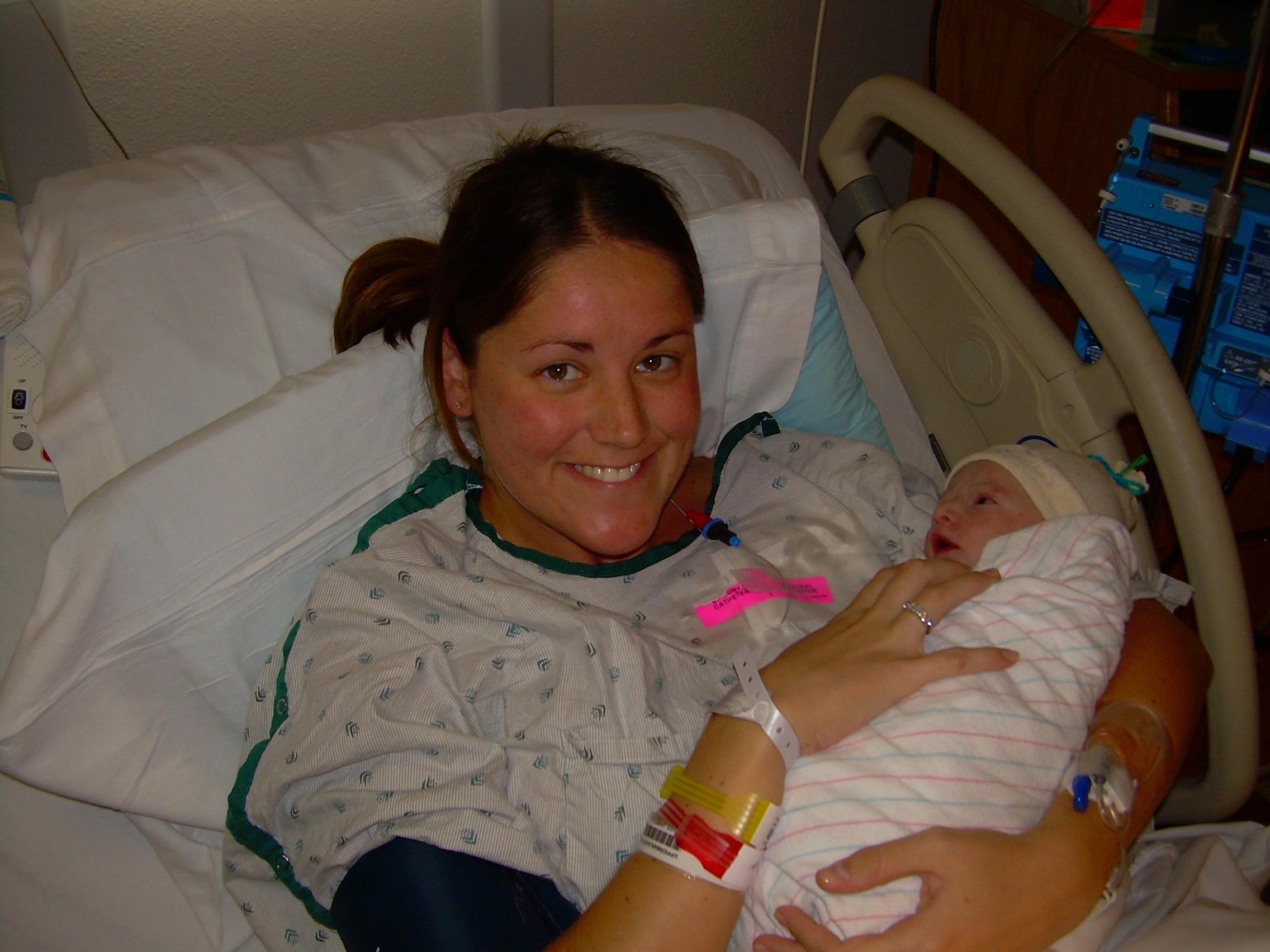
And, this obviously has nothing to do with Road Trip Wednesday, writing, or the five senses, but I have to share… Four years ago today this happened:

I know I look about 14 in this picture, but I was actually 26, wearing no make-up and fresh from a sobfest.

I’ll resist the urge to weep about how fast time flies and how I sometimes wish I could rewind my life four years into the past so I can experience baby-hood all over again. Most days, though, I’m happy to stay in the now because I get to hang out with my smart, sweet, loving little cutie pie. She never fails to make me smile. Happy Fourth Birthday to my girl! 🙂

For the Birds…

I recently read Anne Lamott’s Bird by Bird (mentioned it in last week’s Reading Wrap-Up). If you’ve yet to read it, I highly recommend picking it up. Bird by Bird is an excellent craft book–not too technical, not too preachy, full of concise,  snappy chapters, and at times laugh-out-loud funny.


As I was perusing Bird by Bird, I got the urge to reread bits of my very first manuscript. As I’ve said before, Novel One is tragically low concept epic teen romance that has lots of sweet little scenes I’ll always love. It also has a forced “plot,” loads of over-writing, and characters that are conveniently clueless. In other words, Novel One is completely unsellable.

Now, I’m sure Novel One’s flaws are run of the mill for first (and second and third) efforts. I made mistakes lots of new writers make, learned as I went, and improved with time. I read tons of YA and piles of craft books, and picked up tips and inspiration and lessons along the way. And, it just so happens that a few of my favorite lessons from Bird by Bird  apply directly to Novel One. I’ll share them as they apply to my own writing and maybe save you some trouble. 🙂

1: BE FLEXIBLE – While writing Novel One, I had a very specific direction for the story. And I took it there, even though at times it felt forced and unnatural.  I also had exact, detailed scenes in mind, scenes I eventually wedged in, whether they fit the overall story arc or not. All this pushing and coercing and throwing around of my writerly weight resulted in a story that reads like this: Say what?!

I failed my characters. I neglected to listen to them. I didn’t let them guide the plot. Instead, I molded them, made them do certain things and act certain ways just for the sake of the storyline (which, honestly, wasn’t even all that strong). What I should have done was let the plot grow and expand and change as I got to know my characters.

2: DO NOT BE AFRAID – The earliest drafts of Novel One are so very vanilla. I followed all the rules. I didn’t let my characters swear. I barely let them kiss. They all drove nice cars and lived in tidy houses in a lovely town. They spoke politely and made good choices. Sure, a few bad things happened to them, but through no fault of their own. These people–their lives–were flawless. The reason for all this vanilla? I was afraid of what people (my parents, my husband, my friends) would think if I really went there.

Over time, I’ve developed courage and an anything-goes attitude. What difference does it make if one of my characters drops an F-bomb? Who cares if she wears a skanky top or drinks a beer once in a while? So what if she thinks about school and friends and family and boys and–gasp!–sex? If she’s in character and the story is moving forward, she can do no wrong. But I never went to any of those places in Novel One because I was too focused on my mental naysayers, watching them shake their heads and wag their fingers, listening to them preach about what’s appropriate. And now the story’s a snoozefest.

3: GET IN THE ZONE – Novel One is choppy and lacking in voice. This is partly to blame on my previous lack of flexibility (and experience), but my failure to get in the zone and stay there is also responsible. By “the zone” I mean that delightfully elusive place where you’re focused and typing and barely thinking. Suddenly you glance at the clock and three hours have passed. You’ve written 5K words without ever looking up from your computer screen.

For me, the zone is a silent room, a comfy chair, and a burning candle. I have critique partners who find their zone while listening to loud music through headphones. Others like to work at a certain table in a specific coffee shop with an iced Chai beside them. I need to be in my the zone in order to listen to the voices in my head. I need to listen to the voices in my head in order to find MY voice. (Is this all making me sound slightly crazy? I’m not alone, right?)

I didn’t know about the zone while writing Novel One. I wrote whenever and wherever, and it always took me ages to find a groove–if I did at all. Now I try hard to give myself the best writing conditions possible because only when I get into the zone does my best writing emerges.


I’d love to hear about your first manuscript. What beginner mistakes did you make? What craft books have you found most helpful?

RTW: *Mistakes are the portals of discovery…


Road Trip Wednesday is a ‘Blog Carnival,’ where the ladies at YA Highway post a weekly writing- or reading-related question for participants to respond to on their own blogs. You can hop from destination to destination and get everybody’s unique take on the topic.

This Week’s Topic: What’s the biggest writing/querying/publishing mistake you’ve made so far?

I’ve yet to do anything colossally stupid or embarrassing (I’m sure my time will come), though I have made mistakes that have slowed my progress. I’ve neglected to research (which explains why my first YA manuscript [a tragically low-concept contemporary] clocked in at approximately 130,000 words). I’ve queried too soon (yes, that same first manuscript), and I’ve entertained the wildly unproductive belief that I am the exception. But my biggest mistake, the one I’ve since remedied and will never, ever make again, is trying to make it as a writer all by myself.


Good news: That first manuscript? The tragically low-concept contemporary? It somehow snagged me a critique partner (the amazingly talented Heather Howland), who tore it up in the kindest of ways . In the process, she taught me all about voice, word choice, and plot, and also hooked me up with some of her writing friends (including my other two amazingly talented critique partners Jus Accardo and AE Rought).

In the interest of inserting myself further into the YA writing community, I started blogging and tweeting and interacting with all kinds of fantastic people (both online and local). Can you guess what happened next? I’ll tell you: Writing became easier. And more fun. I felt less crazy. Less alone. I also learned a lot, and my writing improved in the process.

I’m not sure what I would do without the YA community, and I’m not sure how my sanity survived that first manuscript without my critique partners and writing friends. (My husband might say it didn’t survive. Hmm…).

For more, check in Friday. I’ll share some of my favorite online writing communities. Also, stop by YA Highway to see how other participants answered this question.

Do tell… what’s the biggest writing/querying/publishing mistake you’ve made so far?

*The wise words of James Joyce.

Quotables


First and most importantly, a HUGE congratulations to my adorably Australian, super supportive, and terrifically talented friend Amie Kaufman, who has recently signed with Tracey Adams of Adams Literary. Amie writes YA and MG, and if the snippets of her work I’ve read during blogfests and contests are any indication, she’s amazing! Amie also runs a fantastic blog that you should definitely be reading. Learn more about her signing HERE. Congrats, Amie… I’m so very happy for you!

In other news, Monday blogging is always sort of hard for me. I often find myself wondering, What to write, what to write, what to write? But while procrastinating online the other night (something at which I’ve become alarmingly adept), I came across a website full of quotes on writing. Some were inspirational, some were snarky, a few were pretentious, and some were humorous. Several are worth sharing…

Don’t tell me the moon is shining; show me the glint of light on broken glass.  ~Anton Chekhov

The most essential gift for a good writer is a built-in, shockproof shit detector.  This is the writer’s radar and all great writers have had it.  ~Ernest Hemingway

One must be drenched in words, literally soaked in them, to have the right ones form themselves into the proper pattern at the right moment.  ~Hart Crane

Writing a book is a horrible, exhausting struggle, like a long bout of some painful illness.  One would never undertake such a thing if one were not driven on by some demon whom one can neither resist nor understand.  ~George Orwell

A good style should show no signs of effort.  What is written should seem a happy accident.  ~W. Somerset Maugham

You write to communicate to the hearts and minds of others what’s burning inside you.  And we edit to let the fire show through the smoke.  ~Arthur Polotnik

Be obscure clearly.  ~E.B. White


Storytelling reveals meaning without committing the error of defining it.  ~Hannah Arendt

I love writing.  I love the swirl and swing of words as they tangle with human emotions.  ~James Michener

And my very favorite, from “Great Rules of Writing”:

Do not put statements in the negative form.
And don’t start sentences with a conjunction.
If you reread your work, you will find on rereading that a
great deal of repetition can be avoided by rereading and editing.
Never use a long word when a diminutive one will do.
Unqualified superlatives are the worst of all.
De-accession euphemisms.
If any word is improper at the end of a sentence, a linking verb is.
Avoid trendy locutions that sound flaky.
Last, but not least, avoid clichés like the plague.
~William Safire

What are your favorites quotes on writing?

DIVERGENT ARC Winner! (And a Friday Five)

And the winner of a Divergent ARC is…

PAM HARRIS

Pam, please email me your mailing address at katy(dot)upperman(at)live(dot)com. I will mail your book out as soon as I hear from you. 🙂 

Thanks so much to all who entered, subscribed to the blog, and tweeted about this contest. If you didn’t win, please do stop by Alicia Gregoire’s blog, Slice of the Blog Pie. She’s hosting a Divergent ARC giveaway too! You can also purchase your very own copy of Divergent on May 3, 2011.

For the record, if I was a part of the Divergent world and had to chose a faction, I’d totally pick Amity. I like red and yellow, I have a not so secret wish to live on a farm, I hate conflict, I enjoy being outdoors, and I’m a hippie at heart. 

And, in celebration of Friday’s arrival (finally!), here are five blog posts  I loved this week:

1. Roni Loren’s How to Amp Up Sexual Tension in Your Story

2. Natalie Fischer’s Why I’m Scared (To Self-Publish)

3. Amie Kaufman’s Can Jack Write Jill? Writing Across Gender Lines

4. Anne R. Allen’s What If Someone Steals Your Plot?

5. Kate Hart’s YA Deals by the Numbers: Single vs. Multi Book Deals by Genre

Have a wonderful weekend! 🙂

First vs. Third

Exciting news: I’ve written the first scene of what will hopefully be my next manuscript, a little project I’m affectionately referring to as BUS WIP!!! (yep, with three exclamation points–not sure why, but every time I type BUS WIP!!! they’re there).

I’ve actually written this first scene twice. I’m experimenting, you see, with the POV I want to use for the story. I’m pretty sure I want to “hop heads” and my original instinct was to do dual first person POVs. Now, I’m not so sure. I’m starting to think that close third person might be more effective and, and I don’t know… professional sounding? The problem is this: I’ve always sort of thought I was incapable of writing in third person and honestly, I have a bit of an attitude about third person in general, especially in YA books. Often, it feels too distant.

Recently thought, I read Lisa McMann’s CRYER’S CROSS. In it, she used third-person, present tense and I thought it worked brilliantly. The right amount of distance for a creepy, horror kind of story, and an urgent, quick pace that worked really well for the subject matter.

While BUS WIP!!! is no horror story, I do intend for it to have short, suspenseful, action-packed scenes and a fast pace (whether I will actually pull this off is to be determined :)). So, present tense feels right. And shockingly, so does the close third person POV, but only after I wrote this first scene in first person, then converted it to third.

Confused yet? Here are the first few (tentative) sentences of BUS WIP!!! –

In first person, present tense: 
        When I first notice Jace Bryant peeking at my Chem test, I can’t quite believe it. He’s supposed to be this all-around brilliant guy—Mr. Upstanding. He always seems to know everything, excels at anything he attempts. He wouldn’t possibly copy off me. Would he?       
        But then he does it again, this subtle stretch of his neck that allows him the perfect view of my test packet. He makes a mark on his paper, taps his pencil eraser on the desk a few times, then goes about the whole show again. Jesus! He is copying.

And in third person, present tense:
        When Lia Bonelli first notices Jace Bryant peeking at her Chem test, she can’t quite believe it. He’s supposed to be this all-around brilliant guy—Mr. Upstanding. She’s sure this is some kind of fluke; Jace always seems to know everything. He excels at anything he attempts. He wouldn’t possibly copy off Lia. Would he?      
        But then he does it again, this subtle stretch of his neck that allows him the perfect view of her test packet. He makes a mark on his paper, taps his pencil eraser on the desk a few times, then goes about the whole show again. Jesus! Lia thinks, enraged. He is copying.

So? Opinions? Which POV works better based on these little samples? Which POV do you prefer when you’re writing?

In case you’re interested in reading more about the positives and negatives of different POVs, here are a few links that discuss the subject in greater detail:

Tara K. Harper’s First Person or Third
Novel-Writing-Help.com’s First vs. Third Person Point of View
Janice Hardy’s First Vs. Third: Point of View and Character Development
Ingrid Sundberg’s Five Advantages of Third Person Omniscient POV
James Scott Bell’s Understanding the Effects of Your POV
Write It Sideways Which is Best: First or Third Person Point of View?
Tami Moore’s Close Third Person Point of View (I found this one particularly helpful.)

Beginning Again…

I’m starting a new manuscript. Mostly because I had this burst of inspiration a few weeks ago that’s finally had enough time to simmer, but also to help preserve my sanity while trudging through the query trenches.  The idea of “starting to write a book” is so intimidating, and while it’s always a scary prospect, I’ve gotten into a sort of preliminary planning routine that seems to be working for me. While I’m certainly no expert, I’ve done this a few times now, and I thought I’d share a bit about my process.

WIP inspiration...

After I’ve mentally toyed with my shiny new idea for a few weeks (or a few months), I dive in to Lori Wilde’s Got High Concept ebook. Going through her various brainstorming exercises helps me flesh out my idea, narrow the focus of the story I want to tell, and get to the heart of my of my characters’ backgrounds, desires, and vulnerabilities. I’m also able to come up with ways to really challenge my characters, as well as integrate plot devices, enticing topics and universal themes.

By the time I finish with Got High Concept, I’m able to write a compelling pitch that helps me stay focused on the heart of the story. Big rule: the pitch must be twenty-five words or less. Later, I use this pitch to craft a three-line pitch, and then a query. The pitch I came up with for Where Poppies Bloom (before I ever started writing the story itself) was: Guilt-ridden Callie Ryan chooses between life with the golden boy who dulls her pain, or eternal escape with the ghost who holds a dark secret.

Once I’ve zeroed in on the basic premise of the story, I make a really basic list of  the scenes I already have in my head. Then, I tackle a beat sheet, plugging scenes into appropriate places, and coming up with new ones to fill in the gaps. The beat sheet I use is a sort of custom melding of the one in Blake Snyder’s Save the Cat and the summary of steps in The Hero’s Journey. I like a lot of detail. It looks something like this:
 
Ordinary World/Opening Image
Inciting Incident/Call to Adventure
Resistance to Call to Adventure
Meeting with Mentor
1st Turning Point
Pinch #1
Ordeal
Midpoint/Inmost Cave
Rosy Glow/Celebration scene
Pinch #2
2nd Turning Point
All is Lost/Dark Moment
Lightbulb
The Road Back
Climax
Final Image

More WIP inspiration.

It takes me awhile (like, several weeks) to get my beat sheet completely filled in. Once I do, the story starts to feel more manageable, not like the jumbled mess of actions, reactions and interactions it was in my head. I use my beat sheet to then craft a more detailed scene outline, one I follow pretty closely once I begin to write. Of course my scene outline isn’t set in stone. I add and delete as I go, because once I start writing, the story begins to come to life and certain aspects inevitably become more or less important.

And more WIP inspiration...

I should mention that all this planning is done in conjunction with researching whatever aspects of the story I need to (setting, random legal/medical stuff, names, dates, whatever…). While my process may seem formulaic (sometimes I wish I could just start writing and see where I end up!), an organized start is exactly what I need to gain enough confidence to dive in to a two-hundred-fifty page story.

What about you? Are you a plotter? An outliner? A user of Post-It notes? A fly-by-the-seat-of-your-panster? How do you prepare to begin writing a story?

Cutting Words…

I’ve been mentally MIA for the last eight days. Why? I’ve been up to my eyeballs in a fairly significant revision of my manuscript, Where Poppies Bloom. Without getting into all the details, someone recently advised that I cut back the length of my manuscript (originally around 86K), which would, obviously,  pick up the pace. Fifty-ish pages, she recommended. That’s somewhere around 11K words, incase you’re counting.


I’ll admit that it sounded impossible at first. I didn’t think Poppies was dragging. I didn’t think it was wordy or over-written. And my scenes! All the beautiful scenes I’d spent hours planning and writing and editing… some of them were going to have to go. Heartbreaking, I tell you! But, the more I considered it, the more I started to look at this revision opportunity as an interesting sort of challenge.  

So, I copied and pasted the entire 328 page story into a new document and went to work. I figured if I could cut at average of ten useless words per page, I’d be a third of the way to my goal even before chopping full scenes. In an effort to keep myself from becoming completely overwhelmed, I focused on that and dove in.

As I read (and cut), read (and cut), I became very, very critical. Unnecessary dialogue tags were first to go. Next, too-detailed descriptions, then over-expressed emotions. I deleted instances of telling when I’d already shown (I do that sometimes… apparently I worry about being thorough). Finally, I trimmed the beginnings and endings of character conversations in an effort to get to the meat of what was really being said.

When that was all said and done, I took a long, hard look at my scene outline. I figured out which scenes could be deleted entirely (honestly, there weren’t many), which scenes could be combined to streamline the story, and which scenes could become a quick paragraph of exposition. Then I went back to work.

When it was all said and done, I’d trimmed just over 11K words (49 pages) from Where Poppies Bloom. I’m currently three-quarters of the way into a final read through, just to make sure everything still flows, and I have to be honest: I’ve never loved this story as much as I do today. While it was in great shape before, it’s SO clean now. It moves quickly and the suspense is that much greater. I truly believe the revision I once thought was impossible might be the greatest thing to happen to this story, and I’m so glad I took on the challenge.

Care to share your most helpful hints for trimming word count?

Sunday’s Super Seven

Lately, I’ve needed lists to organize my thoughts. That might be because I’m smack in the middle of an epic WIP rewrite (WIP’s scenes, characters, GCMs and all the other tiny details are sorted into lists, might I add) so my head is sort of jumbled. In that spirit, what better day to post a list of super things than boring old Sunday?

1) Words With Friends – Last weekend, my sister-in-law oh-so-innocently asked, “Hey, Katy, have you bought Words With Friends yet?” To which I replied, “No, I sure haven’t. What is it?” She went on to explain that it’s like Scrabble, only you can play on your phone with real friends who play on their phones, or you can start games with random strangers.

SOLD! Scrabble is my very favorite game, and let’s be honest: I’m all about procrastination tools that suck up huge amounts of time before you ever even realize it. Long story short, I bought the app and now I’m in the midst of about eight different games–some with real friends and some with strangers I’ll never meet. I couldn’t be more joyful.

2) Borders – Speaking of joyful, last week I went to Borders and got four new books! (Elizabeth Scott’s The Unwritten Rule, Sarah Ockler’s Fixing Delilah, Deb Caletti’s Honey, Baby, Sweetheart, and Courtney Summer’s Fall For Anything, in case you’re wondering. I’m on a contemporary kick.) As I was perusing, my husband kept our daughter busy, so tolerant and sweet. Mid-browse, I suddenly  realized something: Borders is my happy place.

Now, don’t get me wrong. I find great delight in my family, friends and (most of my) daily activities. But there’s something about walking into Borders with the goal of buying new books that makes me particularly blissful. Do you know what DOESN’T make me blissful? All this talk of Borders going under. I’m not sure if they make 12-Step programs for obsessive book-buyers like me, but I’ll tell you what–if the Borders in my city closes down, things might get ugly.  *Edited February 17th: While Borders has officially filed for bankruptcy, the store in my town is NOT among those listed as closing. What a relief!

3) Craft Quickies – My talented CP, Heather Howland, has started a new series on her blog: Craft Quickies. They’re short posts covering craft issues (obviously) that can trip some (all?) writers up. So far she’s covered dialogue tag abuse (I went through my manuscript with a fine-tooth comb after reading this one) and the stress-inducing possible sequel. Rumor has it she’ll be tackling verb modifiers soon. I highly recommend you check Craft Quickies out.  

4) The Walking Dead – Have you seen this AMC show? From what I’ve heard, it’s an adaptation of a graphic novel and it is the epitome of ridiculousness. Still, I kind of love it.

Hey, girl with the baseball bat: Good luck to you.

We’ve had all seven Season One episodes sitting in our DVR for months and just recently got around to watching them. (I freely admit that we watched with our three-year-old daughter present. She loved it. “Mommy, why are all those zombies eating that horse?” Our status as Parents of the Year may be in question…) Anyway, I love watching The Walking Dead for the very same reason I love watching Dexter and The Vampire Diaries: Something major happens in every. Single. Episode. There are no lags, no weeks and weeks of I know where they’re going with this and I wish they’d just hurry up and get there. Nope. It’s fast paced and exciting and I can’t wait to find out what happens to those crazy zombie fighters next season.

My daughter pretending to be a zombie. In a Princess shirt.

5) Phrase Frequency Counter – The perfect writing tool for closet OCDers like me. Much like Wordle, you can paste in as much or as little text as you want, choose the number of words-in-phrases you’d like the Frequency Counter to check (two-word phrases, three-word phrases, and so on), and then sit back and let the magic happen. The most common phrases in my WIP were things like “I said” and “he said,” but I also noticed that I used “took a long swallow” and “took a long sip” and “took a long drink” three times each. That’s nine times. Clearly, I’m writing about a couple of lushes.

6) Across the Universe  by Beth Revis – As a rule, I don’t read science fiction. I know, I know… I shouldn’t wall myself off completely from any one genre. The thing is, aliens, space travel, cryogenics, and otherworldly futures just don’t interest me. Then Twitter went abuzz about Across the Universe. I became curious. Rave reviews started pouring in. I became intrigued. Some of my CPs read it and couldn’t stop gushing. I knew I had to check it out. So I bought Across the Universe (See  #2 above… I have a problem.), and I am SO glad I did. It’s sci-fi, but it’s accessible. Relatable. Really cool. I’m somewhere around half-way through and I’m totally into it. But now I’m starting to love it so much that I’m stressing about the ending being a disappointment. Ugh. Please, Beth Revis. Please make the end of your book stand up to the fabulous beginning! 

I love this cover...

7) That’s YAmore – In case you haven’t heard: I’m a participant in Oasis for YA’s “That’s YAmore” blogfest. It has been so much fun reading all of the sweet, romantic, steamy entries. If you’re interested in reading my contribution, you can find it HERE. And please visit the That’s YAmore Blogfest page to check out the other participants. You’ll be glad you did. 🙂