Fall Book Club – MISS PEREGRINE


It’s that time! Time to discuss Miss Peregrine’s Home For Peculiar Childrena debut novel by Ransom Riggs. Miss Peregrine was the first book selected for Fall Book Club, brainchild of the lovely Tracey Neithercott.


From Goodreads: A mysterious island. An abandoned orphanage. A strange collection of very curious photographs. It all waits to be discovered in Miss Peregrine’s Home for Peculiar Children, an unforgettable novel that mixes fiction and photography in a thrilling reading experience. As our story opens, a horrific family tragedy sets sixteen-year-old Jacob journeying to a remote island off the coast of Wales, where he discovers the crumbling ruins of Miss Peregrine’s Home for Peculiar Children. As Jacob explores its abandoned bedrooms and hallways, it becomes clear that the children were more than just peculiar. They may have been dangerous. They may have been quarantined on a deserted island for good reason. And somehow—impossible though it seems—they may still be alive. A spine-tingling fantasy illustrated with haunting vintage photography, Miss Peregrine’s Home for Peculiar Children will delight adults, teens, and anyone who relishes an adventure in the shadows.

First, can I just say: This is a beautiful book. The cover is intriguingly spooky, the pages are smooth and thick and creamy-white, the photography is mysterious and thought-provoking, and the chapter pages are burgundy and patterned. Miss Peregrine even has that crisp, expensive-paper scent… such a delight to read.

Overall, I enjoyed this book, mostly because of main character Jacob. He was exactly the type of protagonist I love: sharp, witty, analytical, and intensely aware of his short-comings, which gave a dose of dry humor to an otherwise serious story. And I’ll add: Ransom Riggs is a master of the adverb. I love nothing more, style-wise, than a well placed, brilliantly executed adverb. There were so many in Miss Peregrine, and they totally added to the coolness of Jacob’s personality and voice.

(An interesting side-note: Jacob’s voice reminded me a lot of Miles from John Green’s Looking For Alaska, which is funny because I after I finished Miss Peregrine, I noticed the complimentary blurb by John Green printed on the back of the book’s jacket!)

Now, while I loved Jacob’s narration, I found it to be almost too reflective to be considered YA. That’s not a bad thing, necessarily, but I’m just not sure why the book is marketed to a YA audience. It seems more as if Jacob is looking back on the events from an adult perspective, relaying them to us with a wisdom gained through time and experience, much like Lee from Curtis Sittenfeld’s Prep, an (awesome) adult novel about a teen in boarding school.

Miss Peregrine is a… peculiar story. Hard to define. It’s got a bit of everything: horror, fantasy, history, time travel, romance, and those eerie photographs that gave me the shivers on more than one occasion. The book was so fanciful, in fact, that a plausible conclusion was hard to fathom. I kept wondering if it would  end with Jacob waking up safe and sound in bed, remembering an incredible dream. (It didn’t, just so you know. That would have been so lame!)

Still, the ending, in my opinion, was the tiniest bit unsatisfying. To me, it read as sort of muddled, and it was open-ending (though with a beautiful accompanying photograph). The lack of a hard and fast conclusion bothered me until I read that Ransom Riggs is writing a sequel. I’m quite curious to see where he’ll take Jacob’s story in the next installment.

Miss Peregrine’s Home For Peculiar Children is definitely a book I’d recommend. It’s beautifully written, full of deep, layered characters, and while it deals with themes that are common (finding one’s self, death, overcoming depression), it’s just so different. Worth the read!

Have you read Miss Peregrine? What did you think? And don’t forget to visit Tracey’s blog for links to the other reviews!

RTW: Best Book of September

Road Trip Wednesday is a ‘Blog Carnival,’ where the ladies at YA Highway post a weekly writing- or reading-related question for participants to respond to on their own blogs. You can hop from destination to destination and get everybody’s unique take on the topic.

Today’s Topic: What’s the best book you read in September?

Plot and Structure by James Scott Bell – This one came highly recommended by both Agent Vickie and talented author friend Jessi Kirby. Let’s just say, I was not disappointed. Plot and Structure is one of the best craft books I’ve read and I plan to use everything I learned from it to draft, revise, and rewrite. Clear and concise, fast-paced, and full of fantastic examples. Recommend!

Miss Peregrine’s Home For Peculiar Children by Ransom Riggs – I’m not going to go into this one in too much depth today because I’ll be posting a full review for Fall Book Club on Friday. Please do check back then!

Chain Reaction by Simone Elkeles – I enjoyed the third and final book in the this trilogy more than the second book, Rules of Attraction, but not quite as much as the original, Perfect Chemistry. Nikki and Luis were both fantastic narrators with believable motivations and arcs, but I find this author’s style to be a bit too telling at times. Also, it takes A LOT of violence to upset me, and there was one scene in this book that actually made me feel a little nauseous. Fair warning to the faint of heart.

Forgotten by Cat Patrick – The concept (a girl whose memory “resets” every night, leaving her with no recollection of the past but with strange glimpses into the future) was definitely intriguing. It’s fresh (to YA, anyway), and quite well-written. Main character London was sympathetic and likable, and love interest Luke was adorable. I’ve read reviews stating that the conclusion of this book came out of left field, but I didn’t feel like that at all. I found it to be action-packed and satisfying. Recommend!

And, September’s Best Book of the Month: Revolution by Jennifer Donnelly…


From GoodReads: BROOKLYN: Andi Alpers is on the edge. She’s angry at her father for leaving, angry at her mother for not being able to cope, and heartbroken by the loss of her younger brother, Truman. Rage and grief are destroying her. And she’s about to be expelled from Brooklyn Heights’ most prestigious private school when her father intervenes. Now Andi must accompany him to Paris for winter break. PARIS: Alexandrine Paradis lived over two centuries ago. She dreamed of making her mark on the Paris stage, but a fateful encounter with a doomed prince of France cast her in a tragic role she didn’t want—and couldn’t escape. Two girls, two centuries apart. One never knowing the other. But when Andi finds Alexandrine’s diary, she recognizes something in her words and is moved to the point of obsession. There’s comfort and distraction for Andi in the journal’s antique pages—until, on a midnight journey through the catacombs of Paris, Alexandrine’s words transcend paper and time, and the past becomes suddenly, terrifyingly present. Jennifer Donnelly, author of the award-winning novel A Northern Light, artfully weaves two girls’ stories into one unforgettable account of life, loss, and enduring love. Revolution spans centuries and vividly depicts the eternal struggles of the human heart.

I’ve had Revolution sitting on my nightstand since March. It’s outward appearance is a bit daunting, to be perfectly honest. It’s part historical (not my preferred genre) and it’s HUGE (123K words). But, I’d heard some wonderful things about it (particularly from my sister-in-law, who loaned it to me), so I was determined to give it a go.

I’m so glad I did, because this is one stunningly sophisticated novel. While Andi’s voice is authentically YA, the book’s themes are mature, and the subject matter is very graphically addressed. Andi is an addict (she over-uses prescription drugs an effort to cope with her grief), there is much suffering in both time periods, and there are beheadings described in great detail. Seriously.

Because of all its intensity, Revolution is layered and incredibly rich, both in Andi’s present day narration and  Alex’s French Revolution-era journal entries. And Jennifer Donnelly totally takes you there. She’ll make you feel Andi’s deep, deep depression, as well as Alex’s unyielding loyalty.  You’ll hear the soulful guitar music, you’ll taste the crusty bread, and you’ll smell the stench of dirty Parisian streets. You’ll fall for Virgil, who’s subtle yet awesome, and you’ll root for Andi to recover from her loss and her guilt, and to reclaim her life.

Now that I’ve finished Revolution, I want to read the rest of Jennifer Donnelly’s work. I also want to travel to Paris and research the French Revolution and explore the catacombs. It’s that kind of book, one that broadens your horizons and makes you think more critically about the world around you.

Definitely check out Revolution if you haven’t already!

So, what’s the best book you read in September?

Campaign Challenge #2 – Mama’s Imago

The Writers’ Platform Building Campaign, hosted by Rach Writes, is cool way for writers and active bloggers to reach out and network with other like-minded people, thus building our own platforms and helping others to build theirs. The Campaign runs from August 22nd to October 31st and will include three Campaigner Challenges, the second of which I’m posting TODAY! Here are the parameters:

Write a blog post in 200 words or less, excluding the title. It can be in any format, whether flash fiction, non-fiction, humorous blog musings, poem, etc. The blog post should:

-Include the word “imago” in the title.
-Include the following 4 random words: “miasma,” “lacuna,” “oscitate,” “synchronicity.”
-If you want to give yourself an added challenge (optional and included in the word count), make reference to a mirror in your post.
-For those who want an even greater challenge (optional), make your post 200 words EXACTLY!

So, I’m going the way of flash fiction–I just enjoyed it so much the last time! This piece is exactly 200 words and–gasp!–not YA. I hope it speaks to my fellow mothers, particularly those with curious, whimsical, awe-inspiring daughters, like my girlie. 🙂

Her little girl loved anything with wings, real or mythical. Darting turquoise dragonflies and opalescent hummingbirds were just as fanciful as the spritely fairies living in her fantasies.

But the Monarch butterfly most thoroughly mesmerized her. Its metamorphosis, the perfectly mirrored synchronicity of its orange and black wings, its wanderlust. It intrigued her, and caused her imagination to oscitate, stretching it beyond its reaches.

She was a Monarch for Halloween. Every day after, too, she pulled on the onyx leotard and the shimmering tights. Her mama helped her tie the satin ribbons of the great painted wings, smiling when her girl donned the antennae headband as if it were a Princess’s crown.

They explored the woods almost daily, the girl flying ahead on spirited tulle, her mama meandering behind, enjoying the trees, the breeze, the warmth.

Until one day there was a lacuna in the girl’s cheerful chatter.

Her mama looked frantically about the silent, sunny forest, trying—failing—to ignore the dreadful miasma filling her nose and throat, choking her with terror.

And then her girl was there, crouching behind a stump, examining a tiny, emerald chrysalis.

Her mama gathered her close, careful not to crush her delicate wings.


If you enjoyed my Campaign Challenge #2 effort, please do take a moment to visit Rach Writes where you can LIKE my entry. Again, it’s called Mama’s Imago, and it’s number 130. Thanks for visiting!

Banned Books Week…

In case you haven’t heard, it’s Banned Books Week. As a writer of young adult fiction that might be considered “edgy” or for an “older teen audience,” this is an issue that hits incredibly close to home.

Books are most often challenged by people and groups who, at their core, have the best of intentions: To protect children from explicit and/or difficult material. Still, censorship in any form is wrong. Parents have the right and responsibility to keep their children from material they deem inappropriate; librarians, teachers, religious organizations, and politicians do not.

On a personal note:

I am not exactly a restrictive parent. Granted, my daughter is only four, but I’ve never been one to keep her from things other parents might find unsavory. I have friends who won’t let their kids see Snow White and the Seven Dwarfs because “it’s scary.” Yeah… my daughter has watched (and enjoyed) The Walking Dead. In fact, my husband and I used her questions about zombies as a weird sort of teaching moment. Zombies aren’t real… they’re just pretend… those creepers are just regular people wearing crazy make-up.

That said, there are lots (lots!) of things my daughter isn’t ready for. For example, she recently asked me to read her the first Harry Potter book (bless her heart! She’s well aware of how much her mommy loves it!), and I had to explain to her that she’s not old enough for such a story. I don’t doubt that she’d understand the basic good vs. evil concept (she’s seen every Disney movie ever made; heroes and villains are very much a part of her vocabulary), but I’m not ready to expose her to some of Harry‘s darker story lines, particularly the one about his mother sacrificing her life for the love of her child. A little too intense for a four-year-old, I think.

When I am ready to read her Harry Potter, and later, when she’s reading Newbery Honorees and–way down the road–YA fiction, my husband and I intend to use those stories to begin discussions about difficult topics. And why not? Parenting is hard enough without reinventing the wheel. If there’s great literature out there that’ll open up the lines of communication, I intend to use it.

Still, year after year, people and groups continue to challenge books, most often for the following reasons*:

1. The material was considered to be “sexually explicit.”

2. The material contained “offensive language.”

3. The material was “unsuited to any age group.”

2010’s list of Most Challenged Books*:

  1. And Tango Makes Three, by Peter Parnell and Justin Richardson
    Reasons: homosexuality, religious viewpoint, and unsuited to age group
  2. The Absolutely True Diary of a Part-Time Indian, by Sherman Alexie
    Reasons: offensive language, racism, sex education, sexually explicit, unsuited to age group, and violence
  3. Brave New World, by Aldous Huxley
    Reasons: insensitivity, offensive language, racism, and sexually explicit
  4. Crank, by Ellen Hopkins
    Reasons: drugs, offensive language, and sexually explicit
  5. The Hunger Games, by Suzanne Collins
    Reasons: sexually explicit, unsuited to age group, and violence
  6. Lush, by Natasha Friend
    Reasons: drugs, offensive language, sexually explicit, and unsuited to age group
  7. What My Mother Doesn’t Know, by Sonya Sones
    Reasons: sexism, sexually explicit, and unsuited to age group
  8. Nickel and Dimed, by Barbara Ehrenreich
    Reasons: drugs, inaccurate, offensive language, political viewpoint, and religious viewpoint
  9. Revolutionary Voices, edited by Amy Sonnie
    Reasons: homosexuality and sexually explicit
  10. Twilight, by Stephenie Meyer
    Reasons: religious viewpoint and violence
And, a few of the Classics that have been challenged at one time or another*: The Great Gatsby, by F. Scott Fitzgerald, The Catcher in the Rye, by J.D. Salinger, The Grapes of Wrath, by John Steinbeck, To Kill a Mockingbird, by Harper Lee, The Color Purple, by Alice Walker, Ulysses, by James Joyce, Beloved, by Toni Morrison, The Lord of the Flies, by William Golding, and 1984, by George Orwell.

How can we stand up to book challengers?

1. By defending our right to intellectual freedom—the freedom to access information and express ideas, even if the information and ideas might be considered unorthodox or unpopular. We can talk about the danger of restraining the availability of information in our free society.

2. We can voice the importance of the First Amendment and (especially) the power of literature.

3. We can support librarians, teachers, booksellers, and members of the community to who fight to keep “inappropriate” books in library and school collections.

4. We can continue to buy, borrow, loan, read, and recommend banned and challenged books. (Read Twenty Boy Summer! Read Speak! Read To Kill a Mockingbird! Read The Hunger Games! Read The Grapes of Wrath!)


Now, excuse me while I hop down from my soapbox. I want to go read Sherman Alexie’s The Absolutely True Diary of a Part-Time Indian.

How will you celebrate Banned Books Week?

*Statistics and lists borrowed from the American Library Association’s Banned and Challenged Books page. Please do visit the ALA’s site for more information.

7X7… An Award!

My blog received an award! Coolness!

The deal with the 7X7 Award is to share seven past blog articles that fit the superlative given. Then you, lovely reader, get to go and check out those posts, if you’re so inclined. I’m also supposed to share the award with seven other bloggers.

First, thank you so much to Alicia Gregoire for passing this award on to me. She’s adorable and her blog is all kinds of fun (and funny!). Definitely check it out if you’re not already a member of her Lurkdom.

And, without further delay, I present you with my 7 blog posts…

Most Beautiful: This is a hard one! I’m going with my entry for Campaign Challenge #1 – Last Kiss, a piece of flash fiction I’m pretty proud of.

Most Helpful: Probably my hints On Querying or To Plot or Not to Plot, in which I discussed my views on (duh) plotting.

Most Popular: My How I Got an Agent story… I always love to read these too! Good news, good news, GOOD NEWS!

Most Controversial: Hmm… I’m not really a controversial kind of gal, but I last year I did a post on some Bad Advice I heard at a local writing event. You may or may not agree with my thoughts.

Most Surprisingly Successful: Ha! It’s Cookie Day! My readers love their treats. 🙂

Most Underrated: Probably a Tales From the Trenches post entitled To Be, or Not to Be, which is chock-full of fantastic questions writers might ask an agent during The Call. I spent a good, long while compiling those questions!

Most Prideworthy: An oldie but a goodie: A brief but enlightening conversation about publishing…  And a new post about inspiration, plagiarism, and Making It Yours.

And I’d like to share the 7X7 Award with the following fantastic bloggers:

Katharine Owens
Lindsay Currie
Erin Schneider 
Tracey Neithercott
Rebecca Behrens
Chantele Sedgwick
Kirsten Lopresti

Hope you girls have fun with the 7X7 Award!

Road Trip Wednesday: Undercover

Road Trip Wednesday is a ‘Blog Carnival,’ where the ladies at YA Highway post a weekly writing- or reading-related question for participants to respond to on their own blogs. You can hop from destination to destination and get everybody’s unique take on the topic.

Today’s Topic: What are your all-time favorite book covers?

Honestly, this post could have featured fifty book covers… there are SO many I love! But, I managed to narrow my choices to a few that really stand out…

The Sky is Everywhere – I love the contrast in colors, I love the simplicity, I love the asymmetrical heart, I love that this cover is so different from a lot of the YA covers out now. The new paperback version of The Sky is Everywhere is beautiful too, but personally, I’m partial to the original hardcover.

If I Stay – Another cover that’s clean, pretty, and completely encapsulates the mood and beautiful simplicity of the story. I love the burst of red and the font, especially that it’s all lowercase. Again, this book’s paperback cover is lovely, but I’ll always favor the hardcover.

Bad Taste in Boys – The only book on my list that I haven’t read yet! I just can’t get over the awesomeness. So striking. So unique.

In the Woods – The tree branches remind me of creepy fingers reaching out, which is so absolutely fitting to the mood of this novel. I love the contrast of the black and white, and the way the branches appear to fade into fog. Spooky.

Matched – I fell in love with this cover the moment I saw it. That green dress = Gorgeous. The futuristic font = Telling. Pretty girl trapped in a bubble = Intriguing, and so symbolic of Cassia’s journey.

Living Dead Girl – Ugh. That empty little girl’s dress. The domineering man’s leg standing above. The dead leaves. So haunting, right? I almost don’t even like to look at this cover because it reminds me too much of “Alice’s” experiences in the book. Very evocative.

The American Wife – Everything about this cover is perfect, perfect, perfect. Clean, prim, and proper. Just what we want to believe is true about the life of the First Lady. It almost made me envious of that fictional bride pictured. Then I read the book. All was not quite as perfect as it seemed…

Perfect Chemistry – What can I say, other than: HOT. The way he’s touching her face, the way she closes her eyes… These models look exactly the way I picture Alex and Brittany, which makes me love this cover even more. I also love the blurring of the title’s font,  representative of the fast, page-turning quality of this book.

The Giver – So timeless. I love the contrast of the old, withered hand next to the young eager ones. I love the glimmer of light that’s being passed along. I love the dark, mysterious landscape in the background. This is by far my favorite of the many cover versions of The Giver.

So, those are some of my favorite book covers… Which stand out to you?

On making it yours…

You may have seen my tweets about the local writing seminar I attended on Saturday (Sumner, Washington’s Write in the Valley, in case you’re wondering). It was a fun event; small and intimate, with a diverse panel. There were traditionally published authors (Kimberly Derting! Love her books!) and self-published authors, authors of fiction and nonfiction, and a Book Doctor who shared all kinds of useful information.

The audience was full of writers, both starting out and experienced, and some fantastic questions and conversations came up. One topic that seemed to dominate much of the discussion, though, was that of plagiarism. People seemed very afraid of copying another writer’s work (unintentionally, I presume) and getting called out on it down the road. They used gentler words to discuss plagiarism (“borrowing” and “honoring”), but the gist was pretty much the same: How can a writer ensure that their work is original when there’s so much published material already out there? 

To be perfectly honest, I’ve never worried about this. There are hundreds of ghost stories on the market, thousands of books set in old houses, innumerable protagonists dealing with the loss of a loved one, countless teens sent to live with relatives, zillions of girls forced to choose between two boys. Yet, I know my story, Where Poppies Bloom, is unique. It’s told from my perspective, with my life experiences to back it up. My characters are original, the setting is my own creation, and my inimitable author voice carries the story. I did the creative work to draft, revise, edit Poppies, and I’m certain that no one else has written (or will write) a story quite like it. Nobody can tell Callie’s story the way I can.

People have been writing stories since they dwelled in caves. To think that you’ve come up with an idea that’s never been done is a little presumptuous and a lot arrogant. My mom and I were just talking about this the other day: She mentioned that every piece of women’s or literary fiction she’s picked up lately has been about a middle-aged, middle-class woman with a cheating husband who has to rebuild her life from scratch. Gosh, I feel like I’ve read that book one or two (or one-hundred) times.

I mean, really… How many fictional YA girls are there out there who have an exceptional ability and are fated to save the world? How many dangerous paranormal boys have we seen fall in love with a Mary Sue? Was Stephenie Meyer the first author to write about vampires? Of course not. Before her was Anne Rice, and before her was Bram Stoker, and before him was John William Polidori. I’m willing to bet every subsequent author drew inspiration from those who came before them. But did they commit an act of plagiarism? No way. They each gave the old vampire tale a spin of their own. Edward Cullen sparkles in the sun… didn’t you hear?

That said, there are only so many basic plots. I’ve found arguments for the idea that there is only one (ONE!) plot with millions of variations. I’ve also seen research that claims there are three (The Basic Patterns of Plot by William Foster-Harris), seven (The Seven Basic Plots: Why We Tell Stories by Christopher Booker), twenty (20 Master Plots: And How to Build Them by Ronald Tobias), and thirty-six (Thirty-Six Dramatic Situations by Georges Polti).

We can subscribe to whatever idea of maximum number of basic plots we want. What’s important is that we embrace that fact that, when boiled way down, there are only so many original ideas. Every story, at its very core, can be sorted into one of these: man vs. nature, man vs. man, man vs. the environment, man vs. machines/technology, man vs. the supernatural, man vs. self, or man vs. god/religion. It’s what we DO with the fundamental “plot” we choose that makes our stories innovative and imaginative and  memorable and ours.

Tell me… What, in your opinion, makes a story unique? 

Friday Fun: Where I Write and What You Eat…

First, a Friday Five from Paper Hangover, a fantastic group blog offering writing tips, book reviews, weekly blog topics, and teen interviews. Here’s today’s prompt:

Oh, sheesh… pictures? Do you really want pictures of various locations around my house? I’ll try to mix it up a bit. Here’s where I like to write…

1. My La-Z-Boy. It was a pregnancy gift from my husband (he may have been a *tiny* bit tired of hearing me complain about my aching back when he bought it five years ago :)), and it’s the most comfortable seat in my house. It’s where I most often write.

2. The kitchen table. Lame-o, but yeah… it’s certainly the most functional sopt for when I need to spread papers and notebooks and index cards out.

3. Target. Weird? Maybe. I used to go to Borders to write during my daughter’s preschool hours, but of course Borders is closed now. So, I’ve recently discovered that Target’s little cafe area is quiet and relatively empty from 10:30-12:30 every day. Also, there’s no free Wi-Fi, is a blessing in disguise. My productivity while a Target is through the roof.

4. Tully’s Coffee. True confession: I really dislike Starbucks. I find it to be very yuppy-ish. Also, the Starbucks near me is always cold and loud. (Why, incidentally, do mothers organize play-dates at Starbucks? Your toddlers aren’t having fun there.) Tully’s, on the other hand, is quiant and adorable and they serve amazing coconut chai tea. I work there every Friday while my daughter is at her Spanish lesson. Look how cute!

5. My desk, but honestly I use this space more to sew. I only work here when I want to feel like a “real” writer. Real writers work at desks, right?

I showed you mine… Now what are your favorite writing spots?

And, a totally unrelated, completely frivolous, sort of funny Would you rather…?

Would you rather give up eating meat forever, or cut all carbs from your diet indefinitely?

Yeah, this is totally a no-brainer for me. I rarely eat mean anyway (and usually only chicken or fish), so I’d gladly lose it in favor of pasta and bread and rice and pastries. That said, I’ve been trying hard to cut back on carbs, and when I do eat them usually go for whole wheat.

Usually… not always. 🙂

Have a fabulous weekend!

RTW: Recurring Literary Elements

Road Trip Wednesday is a ‘Blog Carnival,’ where the ladies at YA Highway post a weekly writing- or reading-related question for participants to respond to on their own blogs. You can hop from destination to destination and get everybody’s unique take on the topic.

Today’s Topic: What themes, settings, motifs, scenes, or other elements do you find recurring in your work?

For my non-writer readers, let’s begin with a few simple definitions (thank you, Wikipedia):

THEME – the unifying subject or idea of a story.
SETTING – the time, location, and everything in which a story takes place, and initiates the main backdrop and mood for a story.
MOTIF – any recurring element in a story that has symbolic significance, a repeated theme or pattern.
SCENE – a unit of drama, provide the building blocks of plot for short stories, novels, and other forms of fiction. 

Themes I tend to favor: overcoming guilt, first love, romantic heartbreak, reclaiming happiness after loss. Settings I love: the Pacific Northwest in general, any location near a body of water, cars (why? not sure…), and I certainly lean toward stories set in the present day. Favorite motifs: water, windows, sweet foods, fire. And scenes I always include: a first kiss,  a first fight, and a first make-up. 🙂


What elements of literature recur in your stories?

A few random-ish things…

Ahh, the start of a new week… I’ve got a few random things to share on this lovely Monday morning:

Last night I watched Disney’s Prom. I’ve wanted to see it since I caught the trailer ages ago, but I don’t make it to a lot of movies and when I have “free” time at home, I’m usually writing or cleaning or reading. So…


I finally got to spend a full ninety minutes lost in high school melodrama. It was glorious. Honestly, I’m partial to any movie set in a high school (The Breakfast Club, Clueless, The Girl Next Door, Grease, and Ten Things I Hate About You are a few of my favorites), and Prom was fairly average high school fare. A little slow, a little fluffy, but still cute enough to hold my attention and leave me with a tiny crush on Jesse, the movie’s bad-boy-heartthrob and, in my opinion, a baby Johnny Depp.


Tracey Neithercott’s Fall Book Club has officially begun! Click HERE for the official stuff (don’t worry, it’s all easy). Wondering what we’re reading?


Ransom Rigg’s Miss Peregrine’s Home For Peculiar Children. I started this weekend and yeah… absolutely loving it so far. I highly recommend you jump into the fun and join the Fall Book Club.

I’m revising again, this time with a heavy focus on pacing. I recently read James Scott Bell’s Plot and Structure (thanks for the recommendation, Jessi Kirby and Vickie Motter!) and it has been immensely helpful. Here’s what my copy looks like:


Sheesh. You’d think I’d never read a craft book! But there’s just something about James Scott Bell’s approach, his simple way of explaining what’s already trapped in the mind of any avid reader, that spoke to me. So, I highlighted the heck out of Plot and Structure, then drafted a revision plan that’s working miracles. Yippee!

Over the  last month I’ve become obsessed with this:


Best workout DVD ever. Seriously. I happily hop out of bed a half-hour early each morning to do it. I love Jillian Michaels’ no-nonsense approach. I love how I feel when I’m done. I love that my daughter now knows what “Down Dog” is. And the results! I’m seeing them! It’s so motivating!

And, finally, these photographs beg to be shared:


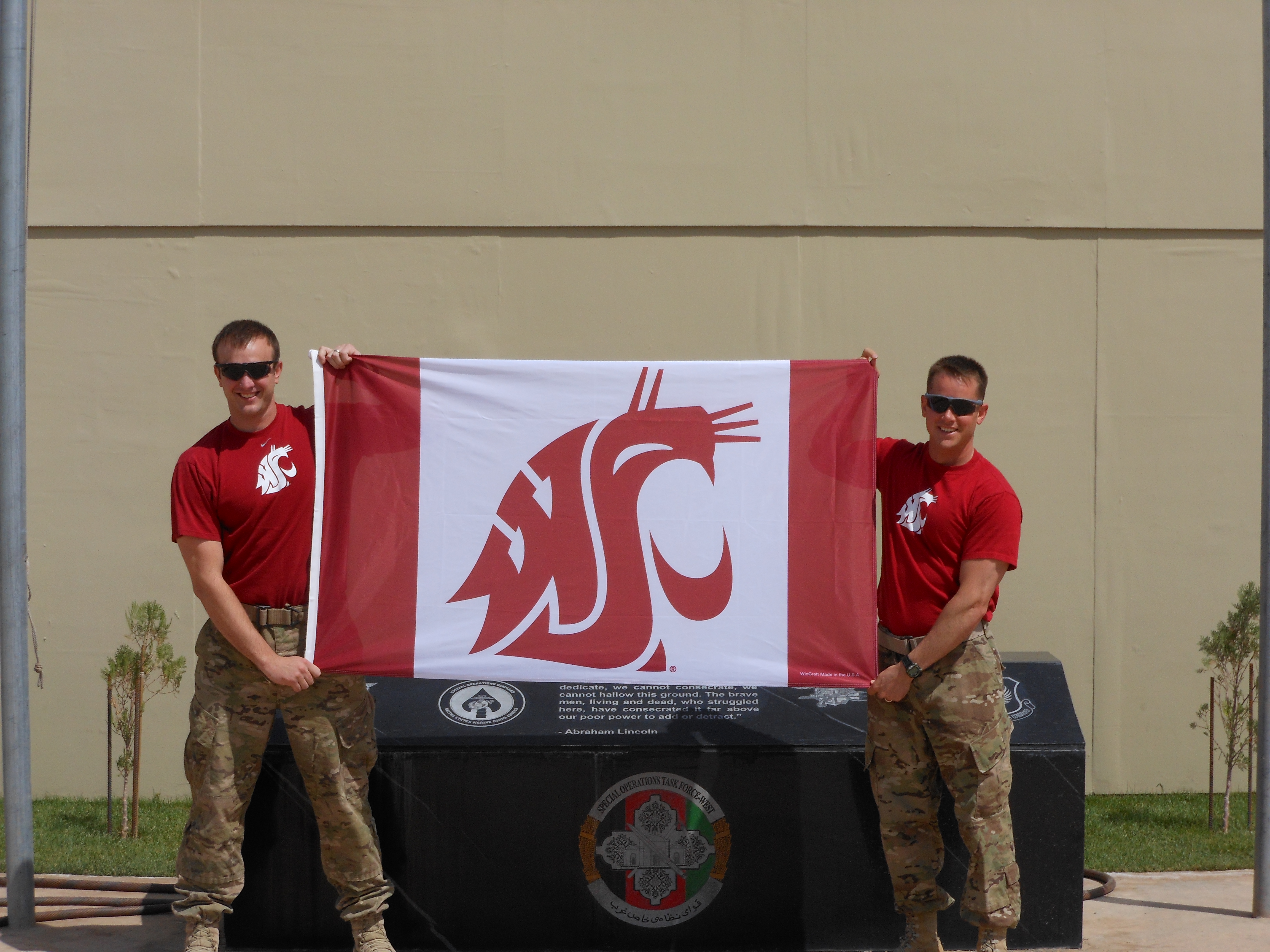
That’s my husband there on the left–you know, the deliciously handsome one :)–and that’s the Washington State University flag he and his buddy are raising in Afghanistan. Yep, our beloved Cougs are representing half-way around the world. Crazy to think about, right?

And one final, incredibly important thing: Happy birthday, Dad! Love you!

So, how was your weekend?